
Are You Making These Common Payroll Compliance Mistakes?

Payroll seems straightforward on the surface. You pay your people, withhold the right taxes, file the forms, and move on. Simple, right?
Not exactly.
The reality is that payroll compliance is one of the most error-prone areas in small business operations. And those errors? They come with real consequences, penalties, back taxes, interest, audits, and sometimes even lawsuits.
The good news is that most payroll mistakes are completely avoidable. You just need to know where the landmines are buried.
Let's walk through the most common payroll compliance mistakes we see business owners make, and more importantly, how to sidestep them before they cost you.
Mistake #1: Missing Tax Filing Deadlines
This one sounds obvious, but it happens more often than you'd think. Between running your business, managing employees, and putting out daily fires, tax deadlines have a way of sneaking up on you.
The IRS doesn't care that you were busy. Miss a payroll tax filing deadline, and you're looking at penalties ranging from 2% to 15% of the tax due, depending on how late you are.
Those percentages add up fast, especially when you're dealing with quarterly filings, annual reconciliations, and state-level requirements that all have their own calendars.
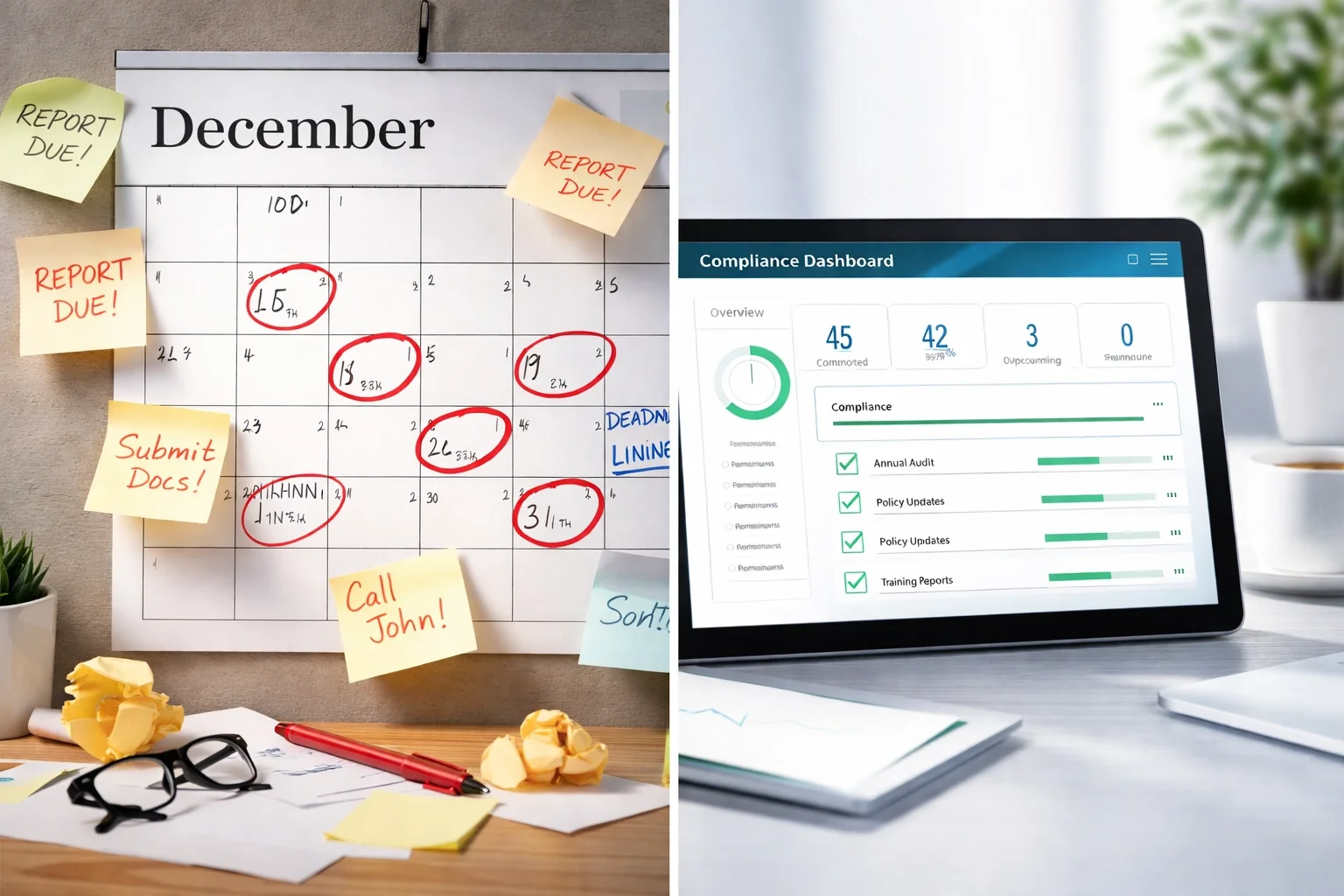
The fix: Build a payroll compliance calendar. Set reminders at least one week before every deadline. Better yet, automate your tax deposits through EFTPS (Electronic Federal Tax Payment System) so you're never scrambling at the last minute.
Mistake #2: Incorrect Tax Withholdings
Federal income tax. Social Security. Medicare. FUTA. State taxes. Local taxes (yes, some cities have their own).
Every single one of these has specific withholding requirements. Get any of them wrong, and you're not just out of compliance: you're potentially liable for the difference, plus penalties and interest.
Common culprits include:
Using outdated W-4 information
Applying the wrong tax rates after legislative changes
Forgetting about state or local taxes when employees work remotely
The fix: Review withholding calculations regularly, especially at the start of each year when tax rates and thresholds often change. Payroll software with built-in tax tables helps, but it's not foolproof: someone still needs to verify the data going in.

Mistake #3: Employee Misclassification
This is the big one. The one that keeps employment attorneys busy and gives business owners nightmares.
Classifying a worker as an independent contractor (1099) when they should be an employee (W-2) is one of the costliest payroll mistakes you can make. If the IRS or Department of Labor disagrees with your classification, you're on the hook for:
Back taxes (employer and employee portions)
Penalties and interest
Unpaid benefits the worker should have received
Potential reclassification audits that dig into your entire workforce
And it's not just the IRS watching. State agencies are increasingly aggressive about misclassification enforcement.
The fix: When in doubt, err on the side of W-2 classification. The IRS looks at factors like behavioral control, financial control, and the type of relationship. If you're telling someone when, where, and how to do their work: they're probably an employee, not a contractor.
Want a deeper dive on this topic? Check out our blog on the 1099 vs. W-2 compliance trap to make sure you're on the right side of the line.
Mistake #4: Outdated or Incorrect Employee Information
It seems minor, but bad data causes big problems.
An old address means undeliverable W-2s. A mismatched Social Security number triggers IRS rejections. Incorrect withholding details based on an outdated W-4 lead to tax notices that take hours to resolve.
And don't get us started on incorrect direct deposit information. One wrong digit, and someone's paycheck lands in the wrong account. Now you're dealing with frustrated employees, bank reversals, and off-cycle payroll runs to fix it.
The fix: Implement an annual employee information audit. Ask employees to verify their personal details, tax withholdings, and direct deposit information at least once a year: ideally at the start of Q1.
Mistake #5: Inaccurate Pay Rates and Deductions
Raises happen. Bonuses get added. Garnishments come and go. Benefits change during open enrollment.
Every one of these adjustments needs to flow through payroll accurately. When they don't, you end up with:
Underpayments that require back-pay corrections
Overpayments that are awkward (and sometimes legally complicated) to recover
Off-cycle payroll runs that eat up time and resources
The fix: Create a clear process for communicating pay changes to whoever handles payroll. No sticky notes. No verbal approvals. Document everything, and build in a verification step before each pay run.

Mistake #6: Botching Overtime Calculations
Overtime errors are lawsuit magnets.
Under the Fair Labor Standards Act (FLSA), non-exempt employees must receive overtime pay at 1.5x their regular rate for hours worked over 40 in a workweek. Sounds simple, but the "regular rate" calculation gets complicated when you factor in bonuses, shift differentials, and commissions.
Data entry mistakes, disconnected timekeeping systems, and manual calculations make overtime errors almost inevitable in some organizations.
The fix: Use integrated time and attendance systems that automatically calculate overtime based on actual hours worked. And if your pay structure includes variable compensation, make sure your payroll system accounts for it in the overtime calculation: not just the base hourly rate.
Mistake #7: Relying on Manual Processes
Spreadsheets. Hand-entered hours. Separate systems for time tracking, benefits, and payroll that don't talk to each other.
This is where errors compound. One typo in a spreadsheet carries forward into every subsequent calculation. Manual data entry between systems creates inconsistencies. And when something goes wrong, good luck figuring out where the mistake originated.
The fix: Automate what you can. Integrate what you can't. Modern payroll systems connect with accounting software, benefits platforms, and HR tools to reduce duplicate entry and create a single source of truth.
Mistake #8: Treating Compliance as a Year-End Problem
This might be the most dangerous mindset of all.
When you only think about payroll compliance in December: scrambling to reconcile W-2s and fix errors before filing deadlines: you've already lost. By that point, mistakes have been compounding for 12 months.
The fix: Compliance is a continuous practice, not an annual event. Monthly reconciliations, quarterly reviews, and real-time monitoring catch problems when they're small and cheap to fix: not when they've snowballed into audit triggers.
The 2026 Curveball: 27 Pay Periods
Here's something most business owners don't see coming: 2026 has 27 biweekly pay periods instead of the usual 26.
If you pay salaried employees biweekly and simply divide their annual salary by 26, you'll end up issuing 27 paychecks: overpaying them for the year. If you reduce each paycheck to accommodate the extra period, you might inadvertently drop exempt employees below the salary threshold required under FLSA.
This also affects benefit limits. FSAs, HSAs, and 401(k) contributions are set by calendar year, not pay period. An extra paycheck can push employees over contribution limits if deductions aren't adjusted.
The fix: Plan for it now. Review your payroll calendar, adjust salary calculations, and communicate with employees before the first paycheck of 2026 goes out.